
Chat with Your APIs: FastAPI, SQLite, MCP, and LM Studio Chat with your APIs

We built a Books ERP you could talk to. It worked perfectly — until we loaded a small local model and watched it print the tool schema instead of calling the tool. That one failure taught us more about local AI than the entire working demo did.
What We Actually Built
The idea was simple: what if instead of a browser or Postman, the interface to an inventory system was a local AI conversation?
You ask: "Show me all python books in stock." The model figures out the right API call. The API runs it. You get a real answer — from the database, not from the model's memory.
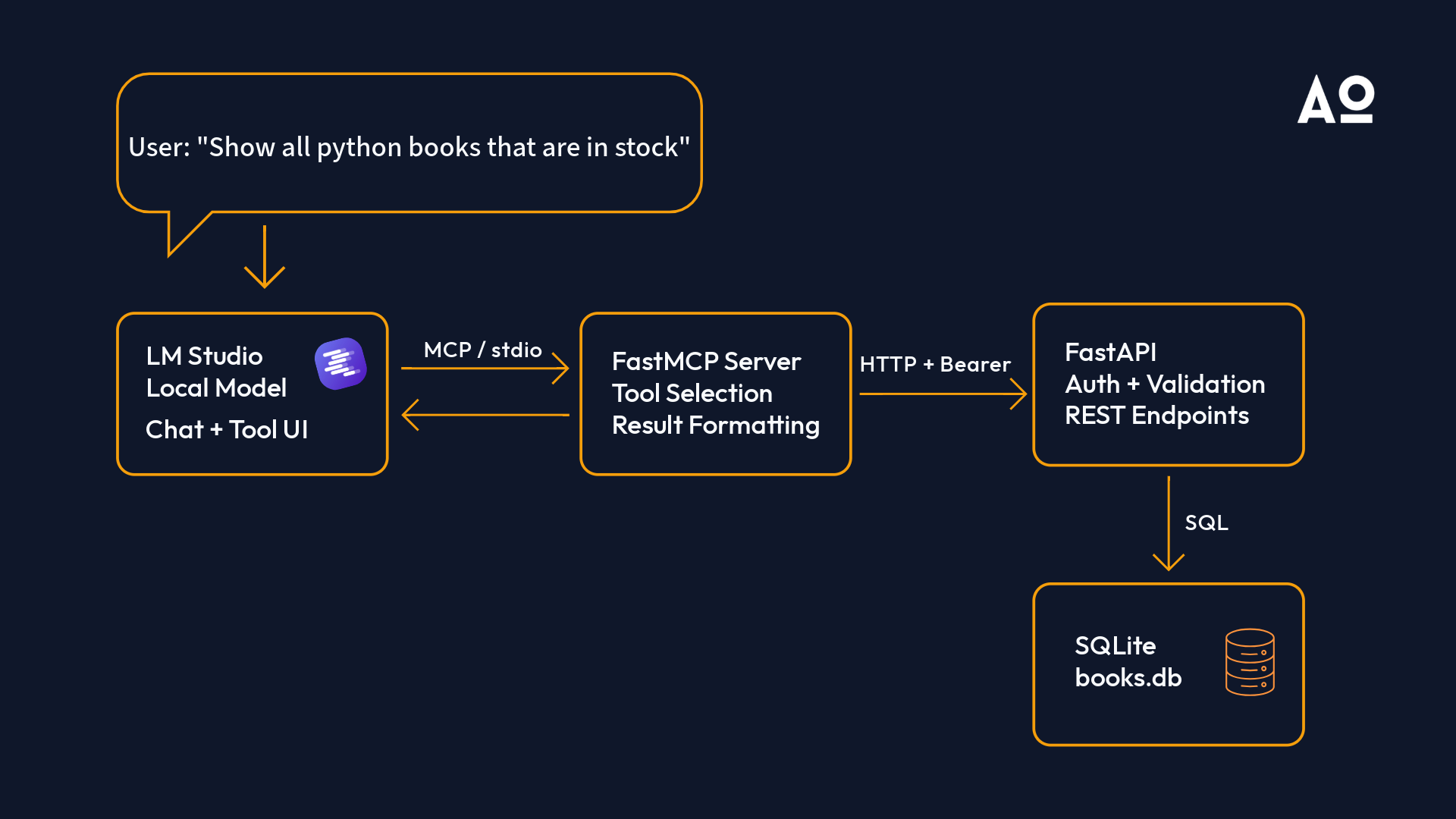
That's the project. A Books ERP with four moving parts:
- FastAPI — REST API for book inventory operations
- SQLite — persistent, zero-config local database
- FastMCP — exposes API operations as LLM tools over stdio
- LM Studio — local model runtime and MCP client
The system supports create, list, filter, search, update, delete, and stats on a book inventory. Every route is protected by a Bearer token. The model never touches the database directly — it goes through the same API boundary that any other client would use.
The Architecture Decision That Matters Most
The tempting shortcut is to let the MCP server import your data store directly:
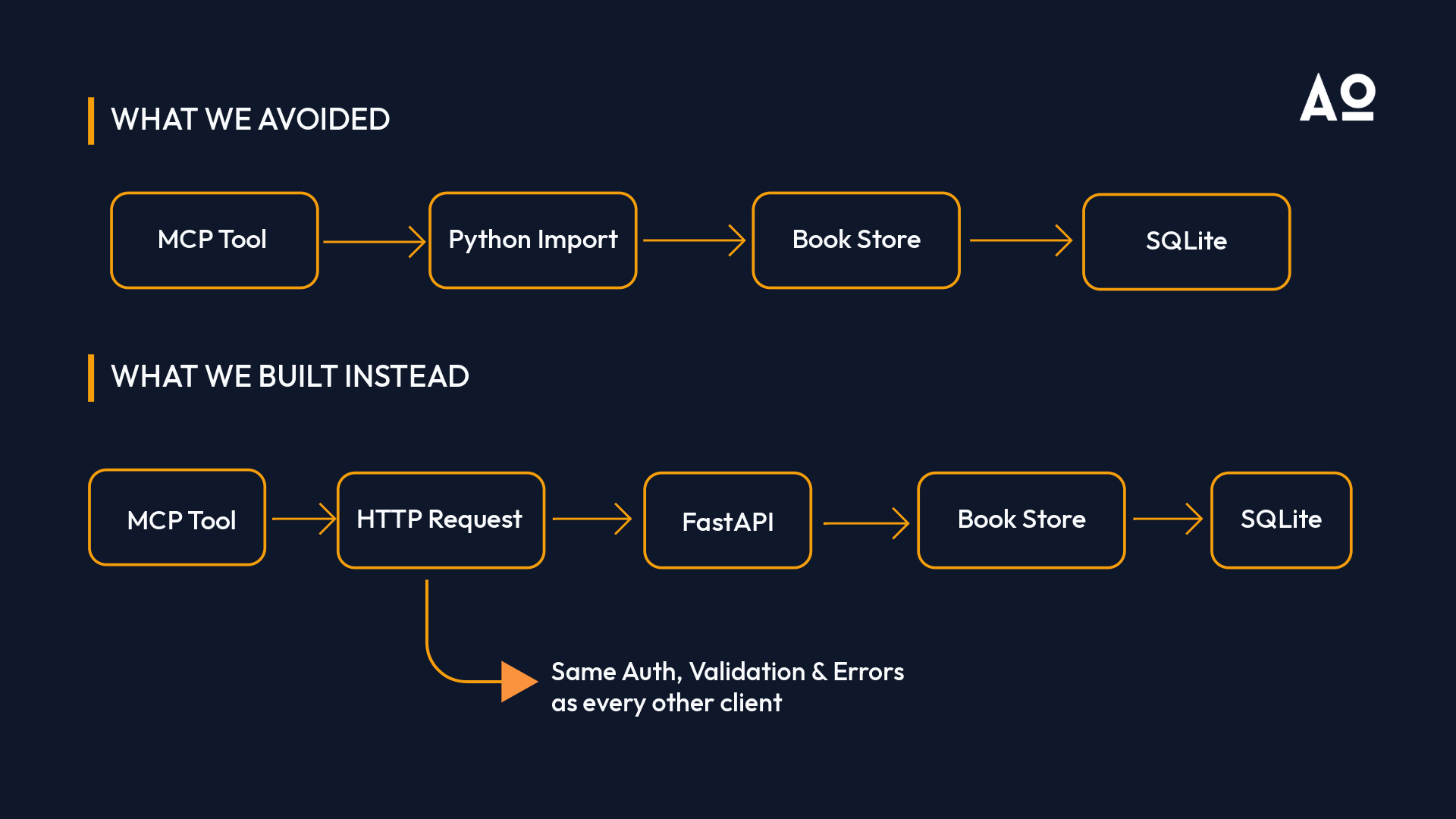
This gives you one invariant that's worth protecting:
No caller — human, script, or AI — can write to your inventory without passing through the same API validation and authentication rules.
In a small local project this feels like extra work. In production, it's what makes AI-initiated writes auditable, testable, and safe to roll back.
The REST API: Build It Like There's No AI
The API lives in api/main.py. Nine endpoints, clean resource-oriented design:
| Operation | Method + Path | Purpose |
|---|---|---|
| Service info | GET / |
Identifies the API |
| Health check | GET /health |
Confirms the service is up |
| Create | POST /books |
Add a book to inventory |
| List | GET /books |
Paginated + filtered listing |
| Search | GET /books/search?q=... |
Full-text across title, author, description |
| Stats | GET /books/stats |
Inventory aggregates |
| Read one | GET /books/{id} |
Single book by ID |
| Update | PUT /books/{id} |
Partial update |
| Delete | DELETE /books/{id} |
Remove a book |
Validation Is the Contract
Pydantic models in api/models.py define what valid data looks like. FastAPI enforces it automatically.
Incoming JSON
     │
     ▼
┌──────────────────────┐
│  Pydantic BookCreate │
│                      │
│  title (1–300 chars) │── invalid ──► 422 Unprocessable Entity
│  price > 0           │
│  date: YYYY-MM-DD    │
│  genre (enum)        │
│  stock >= 0          │
└──────────┬───────────┘
           │ valid
           ▼
┌──────────────────────┐
│  BookStore.create()  │
│  parameterized INSERT│
└──────────┬───────────┘
           │
           ▼
      201 Created
One detail worth calling out: partial updates use model_dump(exclude_unset=True). This means if a client (or an LLM) sends only a price update, the UPDATE statement only touches the price. It will not accidentally set title, author, or stock to NULL. That's a real data-loss bug that's easy to miss — especially when an AI client is constructing the payload.
Persistence: Why SQLite First
The first version of most CRUD apps uses an in-memory Python dict. Fine for explaining API mechanics, useless for a realistic workflow.
SQLite solves persistence without introducing an external service. Python includes sqlite3, the database is a single books.db file, and data survives restarts.
Application start
      │
      ▼
BookStore(db_path)
      │
      ├── open SQLite connection
      └── CREATE TABLE IF NOT EXISTS books

              id            autoincrement PK
              title         required text
              author        required text
              isbn          required text
              genre         required text
              price         required number
              stock_quantity required integer
              description   optional text
              created_at    UTC ISO string
              updated_at    UTC ISO string
All queries use ? placeholders — no string interpolation, no SQL injection risk through book titles or search text.
For a local, single-node ERP this is exactly the right call. If you need concurrent writers, replication, or multi-instance deployment later, the REST API boundary makes the migration local to the storage layer. Nothing else changes.
Security: The API Boundary Is the Trust Boundary
Every /books route depends on verify_token from api/auth.py. The token comes from BOOKS_API_TOKEN (default: secret-token-123 for local dev).
Request: GET /books
Authorization: Bearer <token>
              │
              ▼
      ┌───────────────────┐
      │ Header present?   │── no ──► 401 Unauthorized
      └─────────┬─────────┘
                │
      ┌───────────────────┐
      │ Scheme = Bearer?  │── no ──► 401 Unauthorized
      └─────────┬─────────┘
                │
      ┌───────────────────┐
      │ Token matches?    │── no ──► 403 Forbidden
      └─────────┬─────────┘
                │
           API handler
The mechanism is intentionally simple — this is a local dev setup. The important choice that does generalize to production: credentials are environment variables, never embedded in source code. The MCP server reads the same token and passes it as a Bearer header on every HTTP request to the FastAPI service.
MCP: Turning API Operations into Model Tools
The MCP server in mcp_server/main.py uses FastMCP with stdio transport. LM Studio starts it as a child process, sends MCP messages over stdin, and reads responses from stdout. The server translates those into authenticated HTTP calls to the running FastAPI process.
LM Studio                              FastAPI Service
─────────                              ───────────────
User: "Find books by Tolkien"
  │
  │  model selects: search_books
  ▼
MCP tools/call (stdio)
  { name: "search_books", arguments: { query: "Tolkien" } }
  │
  ▼
GET http://127.0.0.1:8000/books/search?q=Tolkien
Authorization: Bearer <BOOKS_API_TOKEN>
  │
  ▼
FastAPI → BookStore → SQLite → JSON book list
  │
  ▼
FastMCP result (stdio)
  │
  ▼
LM Studio uses the result to write the answer
Canonical Tools + Intent-Friendly Aliases
Seven core tools map directly to the API:
create_booklist_booksget_booksearch_booksget_book_statsupdate_bookdelete_book
Plus lightweight aliases: get_books, get_all_books, add_book, remove_book, find_books, get_stats.
These aliases aren't extra business logic. They're pragmatic — models naturally reach for verbs like "get", "add", or "remove", and a no-argument get_all_books is far easier for smaller models to call reliably than the full list_books schema with optional filters.
The Real Lesson: Tool Calling Is a Model Capability, Not a Given
This is the part the tutorials skip.
We ran the same MCP server, the same tool schemas, the same FastAPI backend — with a 0.5B model and a larger reasoning-capable model. The results were night and day.
The small model knew the tools existed. It just couldn't call them correctly.
Instead of producing a valid call like:
{"name": "get_books", "arguments": {}}
It sometimes produced:
{"type": "object", "properties": {}, "additionalProperties": false}
That's the tool schema definition — not a tool invocation. The model recognized that something schema-shaped was expected, but couldn't distinguish between "here is the schema" and "here are the arguments".
This is not a server failure. It's a structured-output failure at the model level.
A larger reasoning-capable model completed the full interaction correctly every time:
Understand what the user wants
        │
        ▼
Choose the right tool from the list
        │
        ▼
Produce valid structured arguments (not the schema itself)
        │
        ▼
Wait for the tool result
        │
        ▼
Ground the final answer in that result, not in memory
"Simple tool call" is a misleading description. From the application side, listing books is trivial. From the model side, it requires intent classification, tool selection, correct serialization, state management across a tool result turn, and grounded response generation. Parameter count is not the only variable — tool-use training, chat template, runtime parser, quantization, and reasoning depth all matter.
Practical Guidance for Local Models
- Use a model with explicit tool/function calling support in its chat template
- Start with short, unambiguous prompts: "List all books."
- Keep high-frequency tools simple — zero-argument reads are most reliable
- Use intent aliases as a compatibility measure, not a replacement for a capable model
- Test each layer separately: REST API first, MCP invocation second, LLM orchestration last
- If the model prints schema fragments instead of triggering a call, debug the model/parser combination — not the backend code
End-to-End: Adding a Book Through Chat
Request: "Add Dune by Frank Herbert, ISBN 9780441172719, published 1965-08-01, science fiction, ₹829, 25 copies."
1. USER
   Types the request in LM Studio chat

2. LLM
   Selects create_book, extracts structured arguments

3. MCP SERVER
   Builds JSON payload → POST /books with Bearer token

4. FASTAPI
   Verifies token → validates via BookCreate → calls store.create()

5. SQLITE
   Inserts row, assigns ID, persists timestamps

6. FASTAPI → MCP → LLM
   Created book JSON returns through the full stack

7. LLM
   Responds in natural language using the actual returned ID and values
   — not a guess, not its memory
The API response is the authoritative result. If the insert fails, the model says so — it doesn't generate a confident success message from imagination. That's the discipline the architecture enforces.
Running It Locally
Two separate processes:
# Terminal 1 — start the API
export BOOKS_API_TOKEN="secret-token-123"
uv run uvicorn api.main:app --host 127.0.0.1 --port 8000 --reload
Then configure LM Studio with mcp_server/mcp_config.json.
| Variable | Purpose | Default |
|---|---|---|
BOOKS_API_HOST |
FastAPI base URL | http://127.0.0.1:8000 |
BOOKS_API_TOKEN |
Bearer token for auth | — |
BOOKS_DB_PATH |
SQLite file path | books.db |
Terminal A                    Process B (started by LM Studio)
──────────                    ────────────────────────────────
Uvicorn + FastAPI             FastMCP server
127.0.0.1:8000                stdio
      ▲                            │
      └──── authenticated HTTP ◄───┘

SQLite persists as books.db
What's Worth Improving Next
Three things that matter specifically for an AI-augmented inventory system — not generic backend advice:
1. Audit trail for AI-initiated writes. Right now you can't distinguish between a human using the REST API and an LLM calling the same endpoint through MCP. That distinction matters for debugging, compliance, and rollback. Record the caller identity and tool name on every write.
2. Confirmation for destructive tools. delete_book is a one-line MCP tool. Nothing stops a misunderstood prompt from triggering it. Add a confirmation step in the MCP layer for deletes and updates — especially in a customer-facing deployment.
3. Model regression testing. When you update LM Studio or swap models, tool-calling behavior can silently change. Maintain a small suite of (prompt → expected tool call) pairs and run them against any model change before using it in production.
The Takeaway
Building a local AI feature that's actually reliable comes down to one principle:
Build the backend as if there's no AI. Then let AI use it through the same interfaces as every other client.
FastAPI gives you a strong application contract. SQLite makes persistence accessible without ops overhead. MCP gives local models a standard integration surface. LM Studio keeps experimentation private and practical.
The conversation layer is thin. The application underneath it is real software. That separation is what makes the whole thing work — and what makes it debuggable when it doesn't.
Built with FastAPI · SQLite · FastMCP · LM Studio
Frequently Asked Questions
Quick answers to common questions
Sub: MCP
Tutorials, projects, and deep dives on running AI models locally — covering Edge AI deployment, local LLM inference, MCP integrations, and production-ready AI application architecture.
Get Analog Data in your inbox
Practical breakdowns on AI, edge, infra, and playbooks from the team that ships them. One concise email each week.
What you get
New articles, teardown summaries, and code snippets.
What you don’t
No spam. No forwarded press. Unsubscribe anytime.
Join the list
1,350+ subscribers
We respect your inbox. Unsubscribe anytime.